Evidence that arrives with the job, not after it.
For contractors delivering utility network, trenchless and connections work, starting with water networks. Capture completion evidence the same way for each job type, check it while gaps can still be fixed, and reuse it rather than type it again.
Written for
- 01Contractors on water mains renewal, repairs and leakage-related work
- 02Service connection and multi-utility connection teams
- 03Trenchless installation and rehabilitation specialists
- 04Operations teams in larger delivery organisations
01On record
What each job type needs before it can close
The detail varies by client and contract. The pattern does not: every job type has a known set of photographs, measurements and records, and they are easiest to capture while the ground is open.
On site, a job is done when the ground is reinstated and the gang moves on. In the office, it is done when the client accepts the evidence. The time between the two is where jobs stall.
A photograph from the wrong angle, a depth that was never written down, a reinstatement logged against the wrong job: each one holds a job open. Most of these gaps are predictable. What each job type needs is known before the crew arrives.
- Excavation and connection photographsReceived
- Depth of cover and pipe lengthReceived
- Materials usedReceived
- Reinstatement photographMissing
- Client job referenceReceived
- Supervisor sign-offReceived
| Job type | Photographs | Measurements | Materials and tests | Also kept with the job |
|---|---|---|---|---|
| Service connection New or renewed supply to a property |
|
|
|
|
| Mains repair Burst or leak repair on a live main |
|
|
|
|
| Trenchless section Directional drilling, pipe bursting or lining |
|
|
|
|
| Reinstatement Interim or permanent, footway or carriageway |
|
|
|
|
ExampleGeneric examples, not a specification. Each client’s own requirements decide what a job needs, and the workflow review starts from those.
Talk through your job types02First workflow
First workflow: completion evidence by job type
Start with one job type, one client’s requirements or one place where the same details are typed in twice.
- Evidence defined per job typePhotographs, measurements and materials listed for each job type, with each client’s own requirements added where they differ.
- Prompts at the point of workThe crew is asked for each item in the order the work happens. Field connectivity is assessed early.
- A check when the record arrivesThe office sees what is missing when the record comes in, with street works references and reinstatement dates kept with the job.
- Records that follow the jobThe same evidence is reused for the client submission and the commercial review, rather than typed again.
Then: one job, typed into every system, once
-
On site
Field app, paper sheet or phone photos
First recorded: Job reference, work done, measurements, photographs
-
In the office
Job tracking spreadsheet
Typed again: Job reference, completion date, status, quantities
-
For the client
Client’s submission website or form
Typed again: Job reference, completion details, photographs renamed and uploaded
-
For valuation
Commercial or finance system
Typed again: Quantities and references for valuation and invoicing
Client systems vary
We do not assume any client’s system can be connected. Where one offers no way in, records can be laid out in the order and format it asks for, so whoever submits them works from one complete record. The workflow review establishes what is possible before anything is built.
Initial conversation, then a paid workflow review, a one-workflow pilot and wider implementation. Each step ends with your decision. How we work
03Example
See it in a working day
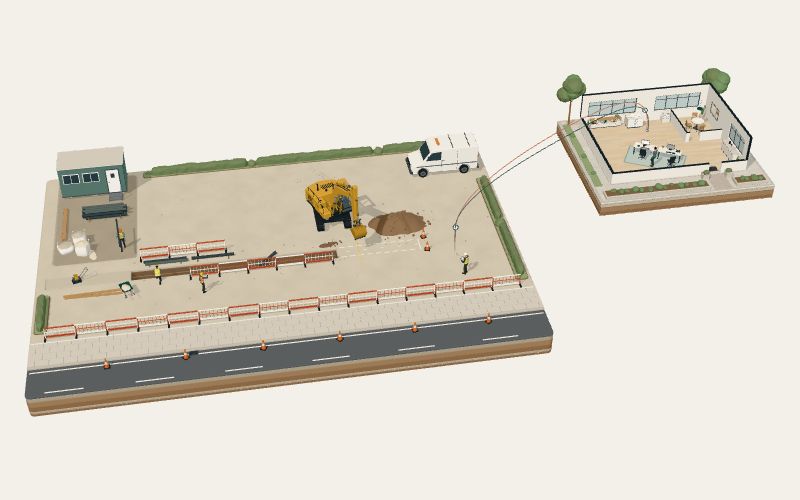
Example3D walkthrough · fictional data
A working day. Connected.
A short 3D walkthrough with fictional data: a duct installation record goes from the supervisor’s tablet to the office, back to site for a missing photograph, and into a job pack.
Open the walkthroughNext step
Which job type takes longest to close?
Tell us about one job type, one client’s evidence requirements or one place where details are typed in twice. We will talk it through and suggest a sensible next step.
Prefer email? hello@oneinfra.co.uk